
INDOOR REPEATER
OUTDOOR REPEATER
PASSIVE DAS
ACTIVE DAS
HYBRID DAS
INDOOR REPEATER
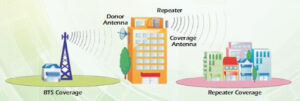
Indoor repeaters are designed to enhance wireless signal coverage and quality within buildings or specific indoor environments. These solutions address areas where network signals are weak due to obstructions such as walls, floors, or large distances from the main signal source.
1. REPEATER TYPES:
- SINGLE, DUAL, TRI, QUAD, PENTA BAND:
Repeaters that support one (single) to five (penta) frequency bands simultaneously. This ensures compatibility with multiple operators and technologies like 2G, 3G, 4G, and 5G, allowing seamless communication across various networks. - ICS (Interference Cancellation System):
Uses advanced algorithms to reduce feedback and interference, improving signal clarity and coverage efficiency. - BAND SELECTIVE:
Targets specific frequency bands to amplify, ensuring optimized performance for selected services and operators. - DIGITAL REPEATERS:
Incorporate digital signal processing for precise amplification, superior filtering, and better adaptability to complex environments.
2. POWER CATEGORIES:
- Low, Medium & High-Power Repeaters:
- Low-Power: Ideal for small indoor areas like offices or single floors.
- Medium-Power: Suitable for larger indoor spaces such as malls or hospitals.
- High-Power: Designed for expansive coverage in buildings with multiple floors or large warehouse.
3. PASSIVE DAS FOR FLOOR AREA COVERAGE EXTENSION:
A Passive Distributed Antenna System (DAS) distributes signals from a repeater to multiple antennas using passive components such as splitters and couplers. It is an economical solution for extending coverage within a building or across multiple floors.
4. IP65 CABINET FOR OUTDOOR APPLICATION:
The IP65-rated cabinet protects repeaters and associated equipment from harsh environmental conditions, such as dust, rain, and extreme temperatures. This makes it suitable for outdoor installations, ensuring reliable performance in challenging environments.
5. COMPONENTS:
- DONOR ANTENNA:
Captures the external signal from the cell tower and sends it to the repeater. - REPEATER:
Amplifies the signal received from the donor antenna and redistributes it to the indoor antennas. - POWER SUPPLY:
Provides the required energy for the repeater and connected equipment. - ANTENNAS:
Indoor antennas broadcast the amplified signal within the building for end-user devices. - SPLITTERS & COUPLERS:
Splitters divide the signal evenly, while couplers distribute specific portions of the signal to different antennas or areas. - RF CABLING:
Connects the components, enabling seamless signal flow and distribution throughout the system.
KEY BENEFITS:
- Enhanced Indoor Coverage: Ensures strong and reliable signals in areas with poor reception.
- Multi-Band Support: Allows simultaneous operation across multiple networks and technologies.
- Flexible Deployment: Scalable solutions for small offices to large complexes.
- Robust Design: IP65-rated cabinets ensure durability in outdoor applications.
- Cost-Effective: Passive DAS and modular components minimize installation and maintenance costs.
This comprehensive solution ensures seamless indoor connectivity for voice and data, enhancing user experience across various environments.
OUTDOOR REPEATER
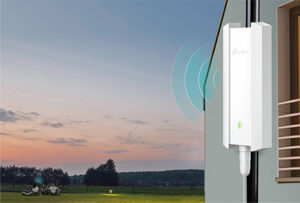
Outdoor repeater solutions are designed to enhance wireless signal coverage and quality in outdoor environments or areas with weak signal reception. These solutions are particularly effective in rural, remote, and large open areas where infrastructure for direct signal access is limited.
1. REPEATER TYPES:
- SINGLE, DUAL, TRI, QUAD, PENTA BAND:
Supports one (single) to five (penta) frequency bands simultaneously, enabling compatibility with multiple networks like 2G, 3G, 4G, and 5G. - ICS (Interference Cancellation System):
Reduces interference and feedback using advanced algorithms, ensuring clear and stable signal transmission. - BAND SELECTIVE:
Amplifies only specific frequency bands to cater to selected operators and services, enhancing performance. - DIGITAL REPEATERS:
Employ digital signal processing for better filtering, accurate amplification, and adaptability to complex outdoor scenarios. - SOLAR POWERED:
Designed for energy efficiency, these repeaters are powered by solar energy, making them ideal for rural and off-grid applications.
2. POWER CATEGORIES:
- Medium & High-Power Repeaters:
- Medium-Power: Suitable for semi-rural areas or moderately dense outdoor environments.
- High-Power: Perfect for large-scale rural deployments, industrial sites, or remote regions requiring extended coverage.
3. OUTDOOR COVERAGE SOLUTIONS:
- Solar Powered Rural Applications:
Enables signal enhancement in areas without reliable access to electricity. Solar-powered repeaters ensure cost-effective and sustainable operation. - IP65 Outdoor Cabinet:
Protects repeaters and associated equipment from environmental factors like dust, rain, and temperature extremes. This ensures reliable and long-term performance in challenging outdoor conditions.
4. COMPONENTS AND CONFIGURATIONS:
REPEATER LOCATION
- DONOR ANTENNA:
Captures signals from the nearest cell tower and transmits them to the repeater. - REPEATER:
Amplifies the received signals and redistributes them to the target coverage area. - SOLAR POWERED:
Ensures uninterrupted operation in areas without reliable grid power, using solar panels and battery backups.
KEY BENEFITS:
- Enhanced Outdoor Coverage: Strong signal coverage for large outdoor spaces, including rural and remote regions.
- Energy Efficiency: Solar-powered solutions ensure sustainability and operational cost savings.
- Multi-Band Support: Seamless compatibility with multiple network frequencies and technologies.
- Durable Design: IP65-rated cabinets protect equipment in harsh outdoor conditions.
- Scalability: Configurable components and modular design allow for flexible deployment based on coverage needs.
This solution ensures reliable outdoor connectivity, meeting the communication needs of users in diverse and challenging environments.
PASSIVE DAS
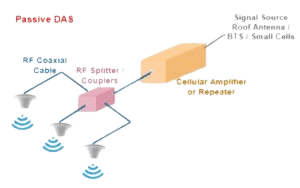 Passive Distributed Antenna Systems (DAS) and In-Building Solutions (IBS) are designed to enhance wireless signal coverage within buildings, ensuring seamless connectivity for 2G, 3G, 4G, and 5G technologies. These solutions rely on centralized equipment and passive components to distribute signals effectively over large floor areas. Here’s a detailed breakdown:
Core Components and Functions:
1. Centralized Equipment Room for Base Stations:
This is the nerve center of the Passive DAS/IBS system, where all primary equipment is housed. It includes:
- Base Stations (BTS & NodeB): Manage 2G and 3G technologies for voice and basic data services.
- eNodeB & gNodeB: Handle 4G LTE and 5G networks, providing advanced data speeds and low latency.
- Point of Interface (POI):
- Combines signals from different bands (e.g., 4G and 5G frequencies) or technologies.
- Optimizes the signal for distribution through the DAS network, ensuring compatibility with multiple operators and technologies.
2. Passive DAS for Floor Area Coverage:
The passive DAS system ensures even signal distribution across large indoor spaces, including high-rise buildings, shopping malls, hospitals, and airports. It consists of:
- Antennas:
- Strategically placed throughout the building to broadcast the signal to end-user devices.
- Ensure uniform coverage in all areas, including basements and hard-to-reach corners.
- Splitters:
- Divide the signal from the centralized equipment into multiple paths.
- Help distribute the signal to multiple antennas across different floors or sections.
- Couplers:
- Direct a portion of the signal to specific areas or antennas.
- Allow precise control over signal strength and coverage in different parts of the building.
- RF Cabling:
- Coaxial cables connect all the components, ensuring efficient signal flow.
- Designed to minimize signal loss, maintaining the quality of the transmitted signal.
System Highlights:
- Multi-Band, Multi-Technology Deployment:
The system supports multiple frequency bands and technologies simultaneously, ensuring compatibility with legacy networks (2G/3G) and modern networks (4G/5G).
- Centralized Equipment Room Benefits:
- Reduces infrastructure clutter by consolidating equipment.
- Simplifies system management and maintenance.
- Passive DAS Advantages:
- Cost-effective: Passive components like splitters and couplers require minimal maintenance.
- Scalable: Can be easily upgraded to include more antennas or support new technologies.
- Reliable: Ensures robust and consistent indoor connectivity without active amplification in the distribution network.
Passive DAS/IBS solutions provide a reliable and scalable way to enhance indoor wireless coverage. With centralized equipment, precise distribution components, and support for modern networks, this system ensures optimal performance for a variety of environments.
ACTIVE DAS
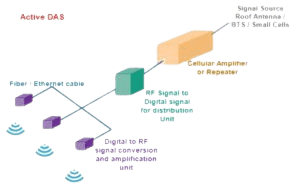
Active Distributed Antenna System (DAS) and In-Building Solutions (IBS) are designed to provide seamless wireless connectivity within indoor environments. These solutions utilize low-power active components to ensure signal distribution across buildings and large facilities while offering centralized control and efficient monitoring.
Key Features:
- Centralized Equipment Room for Base Stations
- Houses critical components like BTS, NodeB, eNodeB, and gNodeB for managing multiple technologies, including 2G, 3G, 4G, and 5G.
- Facilitates centralized control, reducing operational complexity.
2. Low Power Remote Unit (+24 dBm)
- Amplifies signals at remote locations, ensuring adequate coverage across various floors or sections of the building.
- Energy-efficient and optimized for small to medium-sized areas.
3. Integrated Serving Antenna/Output for Distribution
- Serves as the endpoint for delivering amplified signals, ensuring high-quality wireless connectivity.
- Enables seamless signal distribution to end-user devices.
4. Optical Fiber Network for End-to-End Connections
- High-capacity optical fiber backbone enables low-loss, high-speed signal transmission across the facility.
- Ensures scalability and future-proofing for growing connectivity needs.
5. Centralized Monitoring Facility Till Last Mile Connection
- Provides real-time insights into network performance and troubleshooting.
- Ensures optimal operation from the central equipment room to remote endpoints.
Key Components :
- Centralized Equipment Room
- Core hub for managing Base Transceiver Station (BTS), NodeB, eNodeB, and gNodeB.
- Streamlines operations and supports multiple technologies simultaneously.
2. FOR-Master Units and Point of Interface (POI)
- FOR-Master Units handle the distribution of signals to multiple remote units.
- POI combines and manages various frequencies and bands for efficient distribution.
3. Fiber Optical Network
- FMS/LIU (Fiber Management System/Light Interface Unit): Organizes and protects optical fibers.
- Optical Fiber Cable: High-quality cables for robust and loss-free signal transfer.
4. Remote Unit Locations
- Positioned across the building to amplify and distribute signals effectively.
- Equipped with +24 dBm power output and supports SISO (Single Input Single Output) and MIMO (Multiple Input Multiple Output) technologies.
5. Integrated Antennas
- Ensure efficient signal transmission and coverage across the targeted areas.
- Compact design minimizes installation footprint.
Benefits:
1. Enhanced Indoor Coverage
- Reliable wireless connectivity across all areas, including challenging spots like basements or multi-floor buildings.
2. Low Power Consumption
- Energy-efficient remote units reduce operational costs while delivering optimal performance.
3. Scalability
- Modular design allows for easy expansion and adaptability to future technology upgrades.
4. Centralized Monitoring
- Real-time performance monitoring ensures swift issue detection and resolution, minimizing downtime.
5. Future-Proof Technology
- Supports the latest wireless standards and multi-band compatibility, making it ideal for long-term deployments.
This solution is designed to address the growing demand for high-quality indoor wireless coverage in corporate offices, hospitals, shopping malls, and other commercial buildings, ensuring seamless connectivity and user satisfaction.
HYBRID DAS
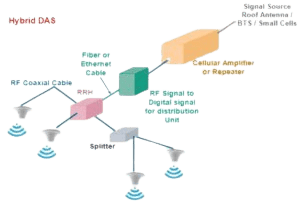 The Hybrid Distributed Antenna System (DAS) and In-Building Solutions (IBS) are tailored for providing seamless wireless connectivity across large campuses and multi-story buildings. These solutions combine active and passive technologies to enable efficient signal distribution over long distances while ensuring robust indoor coverage.
Key Features:
The Hybrid Distributed Antenna System (DAS) and In-Building Solutions (IBS) are tailored for providing seamless wireless connectivity across large campuses and multi-story buildings. These solutions combine active and passive technologies to enable efficient signal distribution over long distances while ensuring robust indoor coverage.
Key Features:
- Fiber Optical Repeater/MDAS-Based Solution
- Utilizes Fiber Optical Repeaters (FOR) or Master Distributed Antenna Systems (MDAS) to extend signal coverage over large distances with minimal loss.
- Ensures high-quality connectivity across sprawling campuses and large buildings.
-
- Houses key components like BTS, NodeB, eNodeB, and gNodeB to support multiple wireless technologies (2G, 3G, 4G, and 5G).
- Simplifies network management by centralizing core operations.
-
- Master Units (MU) and Remote Units (RU) amplify signals for long-distance transmission, enabling coverage of extensive areas.
- Configurable for single to multi-band frequencies, supporting various network operators and services.
-
- Optical fiber links between Master Units and Remote Units ensure loss-free, high-speed signal transmission.
- Allows efficient distribution of amplified signals over long distances.
-
- Combines with active components to provide localized signal distribution within buildings.
- Ensures consistent and reliable coverage in indoor environments.
-
- Real-time monitoring of all components ensures proactive issue detection and resolution, optimizing performance and uptime.
Key Components :
- Centralized Equipment Room
- BTS & NodeB, eNodeB & gNodeB: Support multiple frequency bands and technologies to deliver seamless connectivity.
- FOR/MDAS-Master Units & POI: Master units and Point of Interface (POI) combine and manage signal frequencies for distribution.
- FMS/LIU (Fiber Management System/Light Interface Unit): Ensures organized management of optical fibers.
- Optical Fiber Cable: High-capacity cables for robust, loss-free signal transmission between master and remote units.
-
- FOR-Remote Units: Placed strategically to amplify signals and distribute them over targeted areas.
- High/Medium Power Units: Adjust signal strength based on coverage requirements.
- Optical Fiber Cable: Connects master units to remote units for efficient signal flow.
- FMS/LIU: Manages and protects optical fiber connections at remote locations.
- Passive DAS/IBS: Distributes amplified signals across floor areas using antennas, splitters, and couplers.
-
- Antennas: Deliver the amplified signals to end-users over the designated coverage area.
- Splitters and Couplers: Divide and direct signals for optimal distribution across multiple zones.
- RF Cabling: Connects various components with minimal signal loss during transmission.
Benefits:
1. Comprehensive Coverage
-
- Delivers high-quality wireless connectivity across large campuses, multi-floor buildings, and remote areas.
- Ensures consistent indoor and outdoor coverage, even in challenging environments.
-
- Modular design allows for easy expansion to accommodate additional users, technologiesor bands.
-
- Optimized high/medium power units reduce energy consumption while maintaining robust coverage.
-
- Provides compatibility with multiple network technologies and frequencies, ensuring service for all types of devices.
-
- Real-time monitoring ensures optimal performance, reduces downtime, and simplifies troubleshooting.
-
- Built to support emerging technologies like 5G, making it a long-term solution for connectivity needs.
Indoor repeaters are designed to enhance wireless signal coverage and quality within buildings or specific indoor environments. These solutions address areas where network signals are weak due to obstructions such as walls, floors, or large distances from the main signal source.
1. REPEATER TYPES:
- SINGLE, DUAL, TRI, QUAD, PENTA BAND:
Repeaters that support one (single) to five (penta) frequency bands simultaneously. This ensures compatibility with multiple operators and technologies like 2G, 3G, 4G, and 5G, allowing seamless communication across various networks. - ICS (Interference Cancellation System):
Uses advanced algorithms to reduce feedback and interference, improving signal clarity and coverage efficiency. - BAND SELECTIVE:
Targets specific frequency bands to amplify, ensuring optimized performance for selected services and operators. - DIGITAL REPEATERS:
Incorporate digital signal processing for precise amplification, superior filtering, and better adaptability to complex environments.
2. POWER CATEGORIES:
- Low, Medium & High-Power Repeaters:
- Low-Power: Ideal for small indoor areas like offices or single floors.
- Medium-Power: Suitable for larger indoor spaces such as malls or hospitals.
- High-Power: Designed for expansive coverage in buildings with multiple floors or large warehouse.
3. PASSIVE DAS FOR FLOOR AREA COVERAGE EXTENSION:
A Passive Distributed Antenna System (DAS) distributes signals from a repeater to multiple antennas using passive components such as splitters and couplers. It is an economical solution for extending coverage within a building or across multiple floors.
4. IP65 CABINET FOR OUTDOOR APPLICATION:
The IP65-rated cabinet protects repeaters and associated equipment from harsh environmental conditions, such as dust, rain, and extreme temperatures. This makes it suitable for outdoor installations, ensuring reliable performance in challenging environments.
5. COMPONENTS:
- DONOR ANTENNA:
Captures the external signal from the cell tower and sends it to the repeater. - REPEATER:
Amplifies the signal received from the donor antenna and redistributes it to the indoor antennas. - POWER SUPPLY:
Provides the required energy for the repeater and connected equipment. - ANTENNAS:
Indoor antennas broadcast the amplified signal within the building for end-user devices. - SPLITTERS & COUPLERS:
Splitters divide the signal evenly, while couplers distribute specific portions of the signal to different antennas or areas. - RF CABLING:
Connects the components, enabling seamless signal flow and distribution throughout the system.
KEY BENEFITS:
- Enhanced Indoor Coverage: Ensures strong and reliable signals in areas with poor reception.
- Multi-Band Support: Allows simultaneous operation across multiple networks and technologies.
- Flexible Deployment: Scalable solutions for small offices to large complexes.
- Robust Design: IP65-rated cabinets ensure durability in outdoor applications.
- Cost-Effective: Passive DAS and modular components minimize installation and maintenance costs.
This comprehensive solution ensures seamless indoor connectivity for voice and data, enhancing user experience across various environments.
Outdoor repeater solutions are designed to enhance wireless signal coverage and quality in outdoor environments or areas with weak signal reception. These solutions are particularly effective in rural, remote, and large open areas where infrastructure for direct signal access is limited.
1. REPEATER TYPES:
- SINGLE, DUAL, TRI, QUAD, PENTA BAND:
Supports one (single) to five (penta) frequency bands simultaneously, enabling compatibility with multiple networks like 2G, 3G, 4G, and 5G. - ICS (Interference Cancellation System):
Reduces interference and feedback using advanced algorithms, ensuring clear and stable signal transmission. - BAND SELECTIVE:
Amplifies only specific frequency bands to cater to selected operators and services, enhancing performance. - DIGITAL REPEATERS:
Employ digital signal processing for better filtering, accurate amplification, and adaptability to complex outdoor scenarios. - SOLAR POWERED:
Designed for energy efficiency, these repeaters are powered by solar energy, making them ideal for rural and off-grid applications.
2. POWER CATEGORIES:
- Medium & High-Power Repeaters:
- Medium-Power: Suitable for semi-rural areas or moderately dense outdoor environments.
- High-Power: Perfect for large-scale rural deployments, industrial sites, or remote regions requiring extended coverage.
3. OUTDOOR COVERAGE SOLUTIONS:
- Solar Powered Rural Applications:
Enables signal enhancement in areas without reliable access to electricity. Solar-powered repeaters ensure cost-effective and sustainable operation. - IP65 Outdoor Cabinet:
Protects repeaters and associated equipment from environmental factors like dust, rain, and temperature extremes. This ensures reliable and long-term performance in challenging outdoor conditions.
4. COMPONENTS AND CONFIGURATIONS:
REPEATER LOCATION
- DONOR ANTENNA:
Captures signals from the nearest cell tower and transmits them to the repeater. - REPEATER:
Amplifies the received signals and redistributes them to the target coverage area. - SOLAR POWERED:
Ensures uninterrupted operation in areas without reliable grid power, using solar panels and battery backups.
KEY BENEFITS:
- Enhanced Outdoor Coverage: Strong signal coverage for large outdoor spaces, including rural and remote regions.
- Energy Efficiency: Solar-powered solutions ensure sustainability and operational cost savings.
- Multi-Band Support: Seamless compatibility with multiple network frequencies and technologies.
- Durable Design: IP65-rated cabinets protect equipment in harsh outdoor conditions.
- Scalability: Configurable components and modular design allow for flexible deployment based on coverage needs.
This solution ensures reliable outdoor connectivity, meeting the communication needs of users in diverse and challenging environments.
Passive Distributed Antenna Systems (DAS) and In-Building Solutions (IBS) are designed to enhance wireless signal coverage within buildings, ensuring seamless connectivity for 2G, 3G, 4G, and 5G technologies. These solutions rely on centralized equipment and passive components to distribute signals effectively over large floor areas. Here’s a detailed breakdown:
Core Components and Functions:
1. Centralized Equipment Room for Base Stations:
This is the nerve center of the Passive DAS/IBS system, where all primary equipment is housed. It includes:
- Base Stations (BTS & NodeB): Manage 2G and 3G technologies for voice and basic data services.
- eNodeB & gNodeB: Handle 4G LTE and 5G networks, providing advanced data speeds and low latency.
- Point of Interface (POI):
- Combines signals from different bands (e.g., 4G and 5G frequencies) or technologies.
- Optimizes the signal for distribution through the DAS network, ensuring compatibility with multiple operators and technologies.
2. Passive DAS for Floor Area Coverage:
The passive DAS system ensures even signal distribution across large indoor spaces, including high-rise buildings, shopping malls, hospitals, and airports. It consists of:
- Antennas:
- Strategically placed throughout the building to broadcast the signal to end-user devices.
- Ensure uniform coverage in all areas, including basements and hard-to-reach corners.
- Splitters:
- Divide the signal from the centralized equipment into multiple paths.
- Help distribute the signal to multiple antennas across different floors or sections.
- Couplers:
- Direct a portion of the signal to specific areas or antennas.
- Allow precise control over signal strength and coverage in different parts of the building.
- RF Cabling:
- Coaxial cables connect all the components, ensuring efficient signal flow.
- Designed to minimize signal loss, maintaining the quality of the transmitted signal.
System Highlights:
- Multi-Band, Multi-Technology Deployment:
The system supports multiple frequency bands and technologies simultaneously, ensuring compatibility with legacy networks (2G/3G) and modern networks (4G/5G).
- Centralized Equipment Room Benefits:
- Reduces infrastructure clutter by consolidating equipment.
- Simplifies system management and maintenance.
- Passive DAS Advantages:
- Cost-effective: Passive components like splitters and couplers require minimal maintenance.
- Scalable: Can be easily upgraded to include more antennas or support new technologies.
- Reliable: Ensures robust and consistent indoor connectivity without active amplification in the distribution network.
Passive DAS/IBS solutions provide a reliable and scalable way to enhance indoor wireless coverage. With centralized equipment, precise distribution components, and support for modern networks, this system ensures optimal performance for a variety of environments.
Active Distributed Antenna System (DAS) and In-Building Solutions (IBS) are designed to provide seamless wireless connectivity within indoor environments. These solutions utilize low-power active components to ensure signal distribution across buildings and large facilities while offering centralized control and efficient monitoring.
Key Features:
- Centralized Equipment Room for Base Stations
- Houses critical components like BTS, NodeB, eNodeB, and gNodeB for managing multiple technologies, including 2G, 3G, 4G, and 5G.
- Facilitates centralized control, reducing operational complexity.
-
- Amplifies signals at remote locations, ensuring adequate coverage across various floors or sections of the building.
- Energy-efficient and optimized for small to medium-sized areas.
-
- Serves as the endpoint for delivering amplified signals, ensuring high-quality wireless connectivity.
- Enables seamless signal distribution to end-user devices.
-
- High-capacity optical fiber backbone enables low-loss, high-speed signal transmission across the facility.
- Ensures scalability and future-proofing for growing connectivity needs.
-
- Provides real-time insights into network performance and troubleshooting.
- Ensures optimal operation from the central equipment room to remote endpoints.
- Centralized Equipment Room
- Core hub for managing Base Transceiver Station (BTS), NodeB, eNodeB, and gNodeB.
- Streamlines operations and supports multiple technologies simultaneously.
-
- FOR-Master Units handle the distribution of signals to multiple remote units.
- POI combines and manages various frequencies and bands for efficient distribution.
-
- FMS/LIU (Fiber Management System/Light Interface Unit): Organizes and protects optical fibers.
- Optical Fiber Cable: High-quality cables for robust and loss-free signal transfer.
-
- Positioned across the building to amplify and distribute signals effectively.
- Equipped with +24 dBm power output and supports SISO (Single Input Single Output) and MIMO (Multiple Input Multiple Output) technologies.
-
- Ensure efficient signal transmission and coverage across the targeted areas.
- Compact design minimizes installation footprint.
-
- Reliable wireless connectivity across all areas, including challenging spots like basements or multi-floor buildings.
-
- Energy-efficient remote units reduce operational costs while delivering optimal performance.
-
- Modular design allows for easy expansion and adaptability to future technology upgrades.
-
- Real-time performance monitoring ensures swift issue detection and resolution, minimizing downtime.
-
- Supports the latest wireless standards and multi-band compatibility, making it ideal for long-term deployments.
The Hybrid Distributed Antenna System (DAS) and In-Building Solutions (IBS) are tailored for providing seamless wireless connectivity across large campuses and multi-story buildings. These solutions combine active and passive technologies to enable efficient signal distribution over long distances while ensuring robust indoor coverage.
Key Features:
- Fiber Optical Repeater/MDAS-Based Solution
- Utilizes Fiber Optical Repeaters (FOR) or Master Distributed Antenna Systems (MDAS) to extend signal coverage over large distances with minimal loss.
- Ensures high-quality connectivity across sprawling campuses and large buildings.
-
- Houses key components like BTS, NodeB, eNodeB, and gNodeB to support multiple wireless technologies (2G, 3G, 4G, and 5G).
- Simplifies network management by centralizing core operations.
-
- Master Units (MU) and Remote Units (RU) amplify signals for long-distance transmission, enabling coverage of extensive areas.
- Configurable for single to multi-band frequencies, supporting various network operators and services.
-
- Optical fiber links between Master Units and Remote Units ensure loss-free, high-speed signal transmission.
- Allows efficient distribution of amplified signals over long distances.
-
- Combines with active components to provide localized signal distribution within buildings.
- Ensures consistent and reliable coverage in indoor environments.
-
- Real-time monitoring of all components ensures proactive issue detection and resolution, optimizing performance and uptime.
- Centralized Equipment Room
- BTS & NodeB, eNodeB & gNodeB: Support multiple frequency bands and technologies to deliver seamless connectivity.
- FOR/MDAS-Master Units & POI: Master units and Point of Interface (POI) combine and manage signal frequencies for distribution.
- FMS/LIU (Fiber Management System/Light Interface Unit): Ensures organized management of optical fibers.
- Optical Fiber Cable: High-capacity cables for robust, loss-free signal transmission between master and remote units.
-
- FOR-Remote Units: Placed strategically to amplify signals and distribute them over targeted areas.
- High/Medium Power Units: Adjust signal strength based on coverage requirements.
- Optical Fiber Cable: Connects master units to remote units for efficient signal flow.
- FMS/LIU: Manages and protects optical fiber connections at remote locations.
- Passive DAS/IBS: Distributes amplified signals across floor areas using antennas, splitters, and couplers.
-
- Antennas: Deliver the amplified signals to end-users over the designated coverage area.
- Splitters and Couplers: Divide and direct signals for optimal distribution across multiple zones.
- RF Cabling: Connects various components with minimal signal loss during transmission.
1. Comprehensive Coverage
-
- Delivers high-quality wireless connectivity across large campuses, multi-floor buildings, and remote areas.
- Ensures consistent indoor and outdoor coverage, even in challenging environments.
-
- Modular design allows for easy expansion to accommodate additional users, technologiesor bands.
-
- Optimized high/medium power units reduce energy consumption while maintaining robust coverage.
-
- Provides compatibility with multiple network technologies and frequencies, ensuring service for all types of devices.
-
- Real-time monitoring ensures optimal performance, reduces downtime, and simplifies troubleshooting.
-
- Built to support emerging technologies like 5G, making it a long-term solution for connectivity needs.